- Posted On: 2026-09-05
- Posted By: akash
- Total Views: 300
- Service: Digital Marketing
Shared Cloud Kitchen in Kolkata: Rent, Cost and How It Works
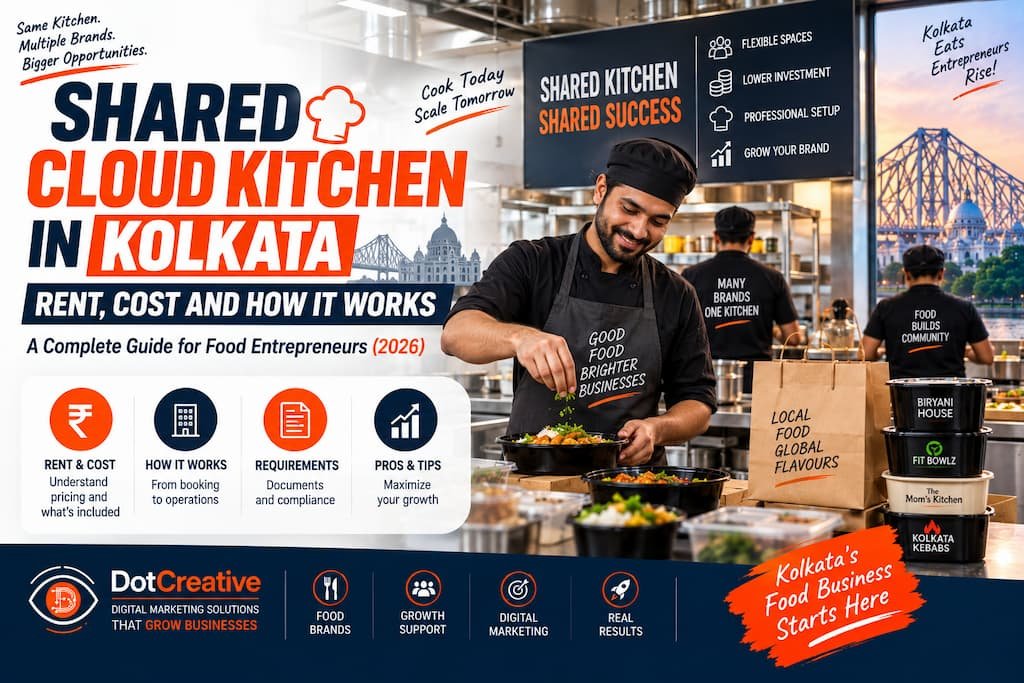
A shared cloud kitchen lets you cook commercially in Kolkata without a lease, a deposit of several lakhs, or a full equipment buy. You rent a ready, licensed kitchen for roughly Rs 10,000 to Rs 30,000 a month, bring your brand, and start. This guide explains exactly how the shared model works, what it really costs, what to check before you sign, and when it is the right move for your food business.
Table of Contents
- What a Shared Cloud Kitchen Actually IsThe Two Types You Will Find in KolkataWho the Shared Model Is Right ForWhat It Really CostsYour Own FSSAI and GST Still ApplyWhat to Check Before You SignHow to Find One in KolkataHonest Pros and ConsWhen to Move In, and When to Move OnYour Shared Kitchen ChecklistFrequently Asked Questions
Your home kitchen is full. The weekend orders are more than one stove and two hands can manage, the fridge is overflowing, and last Saturday you turned away orders you could have sold. But signing a lease for your own space, three to six months of deposit, a full commercial setup, feels like a terrifying leap for a business that is only a few months old.
That gap has a name, and it is the shared cloud kitchen. It is the missing middle rung between cooking at home and running your own place.
What a Shared Cloud Kitchen Actually Is
A shared cloud kitchen is a commercial kitchen that someone else has already built, licensed and equipped, and rents out to multiple food brands at once. You get a cooking station, access to commercial exhaust, plumbing and storage, and you cook your own menu under your own name. The walls and the extractor fan are shared. The brand, the recipes and the profit are entirely yours.
Think of it as a co-working space, but for food. You would not rent a whole office to test a startup with three people; you would take a desk. A shared kitchen is that desk, for a food business.
It is the second rung on the cloud kitchen ladder: home first, shared next, your own dedicated kitchen last. Our complete cloud kitchen guide maps all three; this one is the deep-dive on the shared model.
The Two Types You Will Find in Kolkata
Not all "shared kitchens" are the same, and the difference decides your cost and your control.
1. Rented space (you run everything)
You rent a bare or semi-equipped kitchen station, by the month, shift or hour, and you run your own operation inside it: your staff, your equipment, your ingredients. You get the most control and the lowest running cost, but you handle everything yourself. This is what most independent Kolkata food entrepreneurs mean by a shared kitchen.
2. Managed / aggregator kitchens
Some operators run large "kitchen hubs" where they provide the space plus services: onboarding to delivery apps, some staff, packaging support, even basic marketing, in exchange for a higher fee or a revenue share. You get convenience and speed, but you give up margin and some control. Read the revenue-share terms very carefully; a percentage of sales adds up fast on top of platform commission.
Who the Shared Model Is Right For
- The home kitchen that outgrew home: orders are proven, capacity is the problem.
- Anyone blocked by society rules: a flat that will not allow commercial cooking.
- Testers who need a commercial address: some go straight to shared to get a clean commercial FSSAI and a professional setup from day one.
- Multi-brand experimenters: people who want to try two or three menus without building two or three kitchens.
If you have not yet proven that people reorder your food, the honest advice is still to test from home first. Shared space is cheap compared to a lease, but it is a monthly bill, and a monthly bill against unproven demand is pressure you do not need.
What It Really Costs
The appeal of the shared model is that it removes the two scariest numbers in food: the lease deposit and the full equipment buy. Here is the honest picture for Kolkata.
| Cost | Typical range | Notes |
|---|---|---|
| Monthly rent / seat | Rs 10,000 to Rs 30,000 | Varies by area, size, hours booked |
| Security deposit | 1 to 3 months rent | Far smaller than a dedicated lease |
| Your own equipment | Rs 40,000 to Rs 80,000 | One-time, if not included |
| Packaging (first lot) | Rs 5,000 to Rs 10,000 | Leak-proof, brand stickers |
| Initial raw material | Rs 10,000 to Rs 15,000 | Keep the menu tight |
| Photos, branding, first marketing | Rs 10,000 to Rs 20,000 | Decides your first month |
Realistic start: roughly Rs 80,000 to Rs 1.5 lakh, most of it one-time. Compare that to a dedicated kitchen, where the deposit alone can be more than this entire number. Managed kitchens cost more per month or take a revenue share, so run those numbers against your expected order volume before you commit.
The same two ambush costs from every food business still apply: working capital, because the apps settle weekly while you buy daily, and the commission gap, because platforms take 15 to 30 percent plus 18 percent GST on that commission with no credit back. In a shared kitchen your rent is on top of all of that, so your menu pricing has to carry the lot.
Your Own FSSAI and GST Still Apply
This surprises people: renting a licensed kitchen does not mean you are covered by the operator's licence. The premises are licensed; your brand is not. You still need:
- Your own FSSAI registration, with that kitchen's address on it. Confirm in writing that the operator allows you to register your FSSAI there before you pay a rupee. Some do not, and that is a deal-breaker you want to find out early.
- Your own GST, from your first order, if you sell through Swiggy, Zomato or Magicpin. The 5 percent no-input-credit rate applies exactly as it does for any cloud kitchen.
The full walkthrough of FSSAI, the 2026 threshold change (Basic Registration now covers turnover up to Rs 1.5 crore for Rs 100), the KMC trade licence and the Section 9(5) GST trap is in the complete guide. It applies to you in a shared kitchen just the same.
What to Check Before You Sign
A shared kitchen is a monthly commitment with another business, so treat the agreement seriously. Before you pay, get clear answers, in writing, on all of these:
- FSSAI: can you register your own FSSAI at this address? (Non-negotiable.)
- What is included: equipment, cold storage, exhaust, gas, water, cleaning, waste disposal. What must you bring?
- The true monthly cost: rent plus any electricity, gas, service or platform charges. Ask for a sample full month's bill.
- Peak-hour sharing: how is the kitchen split at the 8pm to 10pm rush, when everyone wants it?
- Notice period: how much notice to leave, and is the deposit refundable?
- Delivery radius: which localities does this address reach inside 30 minutes?
- Multi-brand rules: if you want a second brand later, is it allowed?
A vague, friendly, verbal arrangement is where shared-kitchen relationships sour. Kind people still need clear paperwork.
How to Find One in Kolkata
Shared and rentable commercial kitchens show up on commercial property portals such as 99acres and MagicBricks, on business-listing marketplaces, and increasingly through managed cloud-kitchen operators who run multi-brand hubs across the city. Localities worth checking include Salt Lake, New Town, Ballygunge, Park Circus, Behala and Baranagar, because they combine dense delivery demand with reasonable rent.
Before you fall for any listing, do the free five-minute test: open Swiggy and Zomato, set the delivery pin to that kitchen's locality, search the dish you want to sell, and count how many kitchens already serve it. A cheaper kitchen in a saturated area is more expensive than a slightly costlier one where you can actually stand out.
Honest Pros and Cons
| Pros | Cons |
|---|---|
| No lease, small deposit | Monthly bill against your margin |
| Licensed, commercial space ready | You share peak hours and space |
| Little or no equipment to buy | Less control than your own kitchen |
| Easy to scale up or walk away | Managed kitchens take extra fees or revenue share |
| A clean commercial address for your FSSAI | Quality of operator varies a lot |
When to Move In, and When to Move On
Move in when home has hit its ceiling: steady orders, weekend overflow, or society trouble. Move on to a dedicated kitchen when your volume is high and predictable enough that a full month of dedicated rent and staff costs less per order than the shared setup, or when you need total control of space and timing for multiple brands. Until that math is clearly in your favour, the shared kitchen is doing its job.
 Shared Cloud Kitchen In Kolkata 2026 (Step-by-Step 2026 Guide)
Your Shared Kitchen Checklist
- Prove reorders first (ideally from a home test)
- Shortlist kitchens by locality and delivery demand, not just rent
- Confirm in writing you can register your own FSSAI there
- Get the full monthly cost, inclusions and notice period in writing
- Apply for your own FSSAI at that address (Rs 100 Basic)
- Register GST before your first app order
- Bring leak-proof packaging and a tight menu
- Shoot proper food photos at the new space
- List on partner.zomato.com and partner.swiggy.com
- Track cost-per-order for a month, then decide if you scale or hold
Frequently Asked Questions
What is a shared cloud kitchen?
A shared cloud kitchen is a commercial kitchen space, already licensed and equipped, that you rent by the hour, shift or month instead of building your own. You cook your own menu under your own brand and your own FSSAI, but the physical space, exhaust, plumbing and often basic equipment are provided and shared with other food brands. It lets you go commercial without a lease or a large equipment spend.
How much does a shared cloud kitchen cost in Kolkata?
In Kolkata, shared or rented cloud kitchen space typically runs about Rs 10,000 to Rs 30,000 per month depending on the location, the size of your station and the hours you book, with some operators charging hourly or per-shift. On top of rent you bring your own equipment (roughly Rs 40,000 to Rs 80,000 one-time) if it is not included, plus packaging, raw material and marketing. It is far cheaper than a dedicated kitchen deposit.
Do I still need my own FSSAI and GST in a shared kitchen?
Yes. Even in a shared space, the food brand is yours, so you need your own FSSAI registration tied to that kitchen's address, and your own GST if you sell through Swiggy or Zomato. The operator's licence covers the premises, not your brand. Always confirm in writing that you can register your FSSAI at their address before you pay.
Is a shared cloud kitchen better than working from home?
A shared kitchen is the natural next step after home, not a replacement for it. Home is cheapest for testing whether people reorder. A shared kitchen makes sense once home capacity breaks, you are turning away orders, or society friction is a problem, because it gives you a licensed commercial space without signing a lease or buying a full setup.
What should I check before renting a shared kitchen?
Confirm you can register your own FSSAI at the address, what exactly is included (equipment, storage, exhaust, cleaning), the real monthly cost with no hidden charges, the notice period to leave, how peak hours are shared, and the delivery radius from that location. Get all of it in writing. A vague verbal deal is where shared-kitchen problems start.
Can I run more than one brand from a shared kitchen?
Often yes, and it is one of the model's advantages, but it depends on the operator's rules and your space. Since licences attach to the premises and brand, confirm the multi-brand and multi-listing policy with both the kitchen operator and the delivery platforms before you plan two menus.
Please note: government fees, turnover thresholds and licensing rules change. Figures here reflect rules as of September 2026, including the FSSAI threshold revision effective 1 April 2026. Confirm current requirements on the official portals, and consult a qualified chartered accountant for GST decisions specific to your business.
Where Shared Cloud Kitchens Actually Fail
The space is rarely the problem. Shared kitchens fail when the numbers were never checked: a monthly rent taken on before demand was proven, a revenue-share deal that quietly ate the margin, or a location chosen for cheap rent in an area already crowded with the same cuisine. And they fail, like every food business, when nobody can find the brand online and the first customers never come back. The kitchen gives you a professional base. Being found and being consistent is still the part you have to win.
Related Articles
DotCreative is Kolkata's trusted digital marketing agency - SEO, Social Media, Google Ads and WhatsApp marketing, with 900+ businesses grown since 2016. If your kitchen is ready but the orders are not, that is the part we fix.
Get a Free Consultation