- Posted On: 2026-09-02
- Posted By: akash
- Total Views: 711
- Service: Digital Marketing
Actually Costs and Takes to Open a Cloud Kitchen in Kolkata
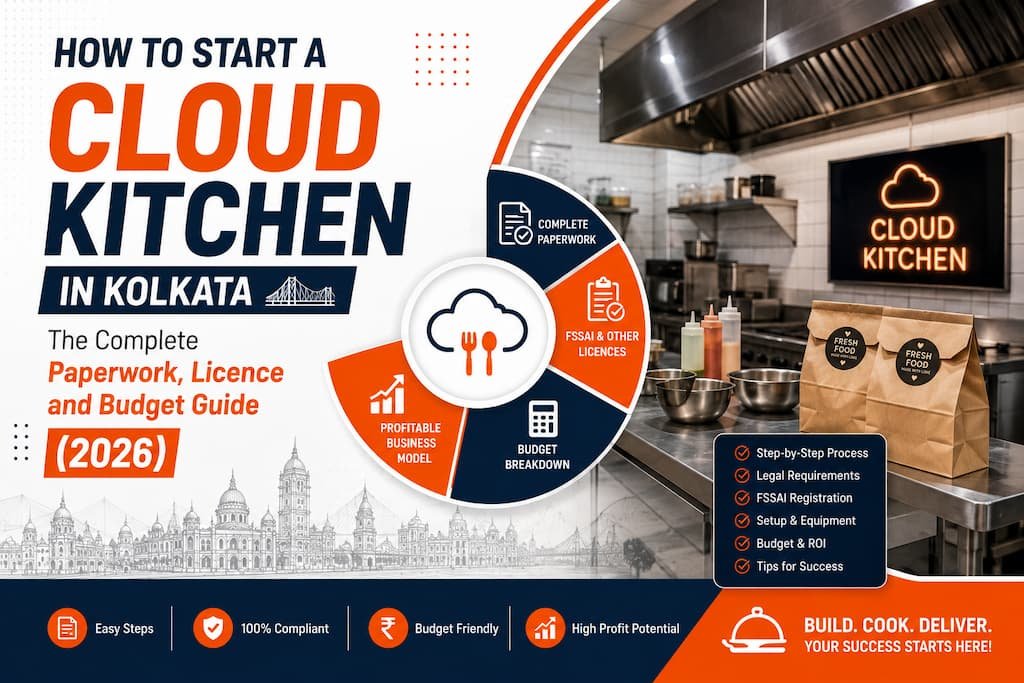
Everything you need to open a cloud kitchen in Kolkata, in order: FSSAI under the new 2026 rules, KMC trade licence, GST, Swiggy and Zomato listing, and what it actually costs. Government fees total roughly Rs 600 to Rs 3,100.
Table of Contents
-
What a Cloud Kitchen Actually Is
Step 1: Decide Who Is Applying
Step 2: FSSAI and the 2026 Rule Change
Step 3: KMC Trade Licence (Certificate of Enlistment)
Step 4: GST, Where Everyone Gets Bad Advice
Step 5: Fire NOC, Shop Act, and Two You Can Ignore
Step 6: Getting Onto Swiggy and Zomato
Step 7: What This Actually Costs
Step 8: What to Cook
Your Checklist, In Order
Where Cloud Kitchens Actually Die
Frequently Asked Questions
Somebody in your family says your mutton kosha is better than any restaurant's. You have heard it for years. One evening, scrolling Swiggy at 10pm, you finally think it: why am I not selling this?
And then, about four seconds later, the second thought arrives and kills the first one. Where do I even start? Do I need a licence? Which one? Is there GST? Do I need a shop? How much money does this take, two lakh? Ten? Who do I even talk to?
That gap, between "I could do this" and "I have no idea what step one is", is where most cloud kitchens die. Not in the market. In the confusion.
So let's close it. This guide walks you from that 10pm thought to your first Swiggy order, in order, with the actual forms, actual websites and actual numbers. You can get a cloud kitchen legally operational in Kolkata for roughly Rs 600 to Rs 3,100 in government fees. Two main documents. About three weeks. And one rule changed this year that makes it far cheaper than any older article will tell you.
What a Cloud Kitchen Actually Is
A cloud kitchen is a restaurant with the restaurant removed. No dining hall, no waiters, no air conditioning for guests, no parking headache, no Rs 15 lakh interior, no signboard on a main road. You cook, you pack, a rider takes it away. Your customer finds you on an app and never once sees your face.
Strip away the dining room and you strip away about 80% of what makes opening a restaurant terrifying. What is left is a kitchen, a licence, and a way for orders to find you. There are three ways to do it, and the order matters.
| Model | What It Is | Best For |
|---|---|---|
| Home kitchen | Cook from your own kitchen | Testing the idea for under Rs 1 lakh |
| Shared kitchen | Rent hours in someone else's licensed commercial kitchen | Outgrowing home without buying equipment |
| Dedicated kitchen | Your own 200 to 400 sq ft space | Real volume, or multiple brands from one kitchen |
Almost everyone who fails started at the bottom of that table. They signed a lease, bought equipment, and then found out whether anyone wanted their food. Start at the top. Let the orders pull you down the table.
Step 1: Decide Who Is Applying
Before a single licence, one decision sits on top of everything: who is the business?
For nine out of ten first cloud kitchens the answer is sole proprietorship. And here is the part nobody explains: a proprietorship has no registration process. There is no certificate. You are the business. Your PAN is the business PAN. In practice you become official the moment you hold a trade licence and a current bank account in your business name.
Private Limited or LLP exists for a different problem: outside investors, partners, personal liability protection. It costs more, demands annual filings, and slows you down for months. You can always convert later, once there is something worth protecting.
Do this before anything else: open Swiggy and Zomato and search your intended brand name. Do it before you print packaging or book a logo designer. Finding out the name is taken after spending Rs 8,000 on stickers is a specific kind of painful.
Step 2: FSSAI and the Rule Change That Just Saved You Thousands
FSSAI is the Food Safety and Standards Authority of India. Every food business in the country needs an FSSAI number, printed on your packaging. Swiggy and Zomato will not list you without it. There is no version of this you can skip.
Until this year the rule was brutal for growing kitchens. Cross Rs 12 lakh in annual turnover, which a kitchen doing Rs 1 lakh a month hits easily, and you were pushed out of the cheap Rs 100 registration into a State Licence, with the inspections and food safety supervisor requirement that come with it.
On 10 March 2026 FSSAI notified new regulations. An implementation order followed on 13 March 2026. From 1 April 2026 the thresholds moved.
| Tier | Old Limit | New Limit (from 1 Apr 2026) | Fee |
|---|---|---|---|
| Basic Registration | Up to Rs 12 lakh | Up to Rs 1.5 crore | Rs 100 |
| State Licence | Rs 12 lakh to Rs 20 crore | Rs 1.5 crore to Rs 50 crore | Rs 2,000 to Rs 5,000 |
| Central Licence | Above Rs 20 crore | Above Rs 50 crore | Rs 7,500 |
Read the first row twice. A kitchen doing Rs 8 lakh a year needs the Rs 100 registration. A kitchen doing Rs 40 lakh needs the Rs 100 registration. A kitchen doing Rs 1.2 crore needs the Rs 100 registration.
The ceiling moved by more than twelve times. If you find a guide telling you to get a State Licence for a new cloud kitchen, that guide was written before April and is now costing its readers money. There is a second gift in the same change: licences and registrations issued from 1 April 2026 stay valid until they are suspended, cancelled or surrendered. No annual renewal scramble.
How to Apply, On the Government Site
One website: foscos.fssai.gov.in, the Food Safety Compliance System. This is the only official portal. Agents around Kolkata will quote you Rs 1,500 to Rs 3,500 to file this. The form costs Rs 100 and takes about forty minutes. Do it yourself.
- Create a login on foscos.fssai.gov.in
- Select Registration, not Licence, then West Bengal, then Kolkata
- Choose the business category matching food preparation for delivery
- Fill Form A. The address must be where the food is actually cooked
- Upload documents, pay Rs 100, submit
- Approval usually lands in 7 to 15 days
Documents to Keep Ready
- Aadhaar and PAN of the proprietor
- Passport-size photograph
- Proof of premises: rent agreement, or an electricity bill if it is your own home
- A written NOC from your landlord, if rented
- A kitchen layout sketch. Hand-drawn on paper and scanned is genuinely accepted
- List of food categories you will produce
That NOC line looks small. It is the single most common reason applications sit stuck for weeks. A landlord who happily agreed on the phone can turn vague when asked to sign something. Get it in writing the same day you agree the rent, before the deposit leaves your account, while you still have leverage.
Real cost: Rs 100 to the government. Maybe Rs 500 more for scanning and printing at a cyber cafe. That is the entire FSSAI expense.
Step 3: The Trade Licence, or KMC's Certificate of Enlistment
FSSAI certifies that your food is safe. The municipality certifies that your business is allowed to exist at that address. Two different questions, two different offices.
In Kolkata this comes from the Kolkata Municipal Corporation, formally as a Certificate of Enlistment. Everyone calls it the trade licence. Apply at kmcgov.in under e-Services, then Trade License.
You register, fill in your business name, address, ward number and nature of trade, upload identity and occupancy proof plus that landlord NOC again, and pay online. An inspector may visit. The digital certificate typically arrives in 7 to 15 working days.
- Cost: Rs 500 to Rs 10,000 and above, scaling with trade type and premises size. A home kitchen or 300 sq ft unit sits near the bottom of that range
- Renewal: every year, before 31 March. Set the phone reminder the day your certificate arrives
The Kolkata detail that trips people up: KMC does not cover everything people casually call Kolkata. Salt Lake falls under Bidhannagar Municipal Corporation, New Town under NKDA, and Howrah and Barrackpore have their own bodies. Applying to the wrong authority means weeks lost and a fee you do not get back. Confirm which municipal body covers your ward before you fill anything.
Step 4: GST, the Section Where Everyone Gets Bad Advice
Slow down here. This is the part that costs real money when it goes wrong.
The Rule You Already Know, and the Exception That Overrides It
GST registration becomes compulsory above Rs 20 lakh turnover, which is the threshold West Bengal uses. But the moment you sell through Swiggy, Zomato or Magicpin, you must be GST registered, even on your first Rs 100 order. The Rs 20 lakh threshold simply does not apply to supplies made through an e-commerce operator.
So for a delivery-app cloud kitchen the honest answer is yes, from day one, before your first order. There is one clean way around it. If you sell only direct, meaning WhatsApp orders, Instagram DMs, your own website and your own delivery, then the Rs 20 lakh threshold does apply to you. Some kitchens deliberately run their first six months this way: no GST, no commission, no monthly filings, just proving that people reorder. It is a legitimate and underrated strategy.
Your Rate, and the Sting Inside It
5% GST, with no Input Tax Credit. That is the rate for standalone restaurants, cloud kitchens and food courts. The no-ITC part deserves your attention. Normally a business claims back the GST it paid on its own purchases. At 5% you cannot. The GST on your rent, your equipment, your packaging and your raw materials all stays a cost you swallow. This should change your menu pricing before you write it, not after your first bad month.
There is an 18% with ITC rate, but it applies only to restaurants inside hotels charging over Rs 7,500 a night. It will never be you.
Section 9(5): the Mistake That Makes Kitchens Pay Tax Twice
When you sell through Swiggy or Zomato, the law treats the platform as the supplier, not you. This provision is Section 9(5), and understanding it is worth real money.
- Swiggy and Zomato collect the 5% GST from the customer and pay it to the government
- You do not charge GST separately on those orders
- You report those supplies in GSTR-1, but exclude them from tax payment in GSTR-3B
- The platform's commission, commonly quoted in the 15% to 30% range, carries 18% GST, which you also cannot claim as credit
Every year, kitchens with well-meaning but unfamiliar accountants pay GST on orders where Swiggy has already paid it. The money is gone and getting it back is a fight. Say four words to your accountant: "Section 9(5) supplies." If they nod, you are fine. If they look blank, find someone who has handled a restaurant client.
The Composition Scheme, and Why It Probably Is Not for You
It sounds ideal: 5% flat on turnover up to Rs 1.5 crore, quarterly filings instead of monthly, far less paperwork. Then you read the condition. You cannot sell through food delivery platforms, and you cannot supply inter-state. If Swiggy and Zomato are the plan, composition is off the table. Consider it only for a pure direct-delivery kitchen.
Register free at gst.gov.in. A CA typically charges Rs 1,500 to Rs 3,000 to register and Rs 1,000 to Rs 2,500 a month for filings. Register yourself if you like, but use a CA for the monthly returns. This is not the place to save money.
Step 5: One Licence You Need Later, One You Must Ask About, Two You Can Ignore
Shop and Establishment Registration
Triggered by your first employee, not by opening. Filed with the West Bengal Labour Department, generally within 30 days of starting operations. It governs working hours, weekly offs, overtime and leave. Cooking alone? Not yet. Hiring a cook next month? Then yes.
Fire NOC
This is conditional, and no blog can answer it for you. Whether you need it depends on the size of your premises, the building category, and your state's rules. A 250 sq ft kitchen in a residential building usually does not trigger it. A large kitchen, or a unit in a tall commercial building, usually does.
Do not guess. Call or walk into your local West Bengal Fire and Emergency Services office, describe your kitchen size and building type, and ask. It is a ten-minute conversation. The alternative is a shutdown notice arriving on a Friday evening. Either way, buy two fire extinguishers. Your landlord will ask, your insurer will ask, and one day a burning pan will ask.
Two Things You Can Stop Worrying About
Older articles still list these and they generate unnecessary panic. PFA (Prevention of Food Adulteration Act) clearance has been replaced by FSSAI and no longer applies. General environmental clearance does not apply to a normal cloud kitchen.
Step 6: Getting Onto Swiggy and Zomato
Paperwork done. Now you need somebody to actually order. Both portals are free: Zomato at partner.zomato.com and Swiggy at partner.swiggy.com. Anyone offering to get you listed for a fee is selling you a form you can fill yourself.
Both platforms want the same set of documents.
- FSSAI licence, mandatory, and precisely why it was Step 2
- PAN card and GST certificate
- Bank details with a cancelled cheque
- Address proof of the kitchen
- Full menu with prices, and food photographs
Timeline: Zomato typically takes 3 to 7 working days, Swiggy 5 to 10 working days.
The Photographs Decide Your First Month
Your customer is not reading about your food. They are scrolling a grid of thumbnails at 9:40pm, hungry, deciding in under two seconds. In that grid your twenty years of cooking experience is invisible. Only the photograph exists.
A Rs 4,000 shoot covering your top ten dishes will outperform Rs 4,000 of platform advertising in month one, comfortably. Shoot in daylight, plain surface, 45-degree angle, and photograph the actual portion you will send. An inflated photo buys you one order and a bad review.
Fill Every Single Menu Field
Descriptions, veg and non-veg tags, spice level, portion size, add-ons. Platform search reads all of it. "Chicken Biryani" loses to "Kolkata-Style Chicken Biryani with Aloo and Egg, Serves 1." Same dish. One of them gets found.
Listing done but orders not coming? Listing optimisation, food photography direction and local search are what decide whether a new kitchen gets seen. DotCreative has been growing Kolkata businesses online since 2016.
Get a Free ConsultationStep 7: What This Actually Costs
Three honest starting points. Kolkata sits at the lower end of national rent averages, which works in your favour.
Option A: Home Kitchen, Rs 35,000 to Rs 70,000
| Item | Cost |
|---|---|
| FSSAI Basic Registration | Rs 100 |
| Trade licence | Rs 500 to Rs 3,000 |
| Kitchen equipment top-up | Rs 10,000 to Rs 20,000 |
| Packaging, first lot | Rs 5,000 to Rs 8,000 |
| Initial raw material | Rs 8,000 to Rs 12,000 |
| Photography and branding | Rs 5,000 to Rs 10,000 |
| First month marketing | Rs 5,000 to Rs 10,000 |
| Buffer | Rs 5,000 |
Monthly running cost: Rs 25,000 to Rs 45,000. Raw material lands around 35% of revenue. A cook, if you hire one, runs Rs 8,000 to Rs 15,000. Check your building society bye-laws and your rent agreement first. In older Kolkata apartment buildings this is a real friction point, and it is much easier to ask than to be asked to stop.
Option B: Shared Commercial Kitchen, Rs 40,000 to Rs 80,000 for Equipment
You bring the equipment, they provide licensed space. Rent runs Rs 10,000 to Rs 25,000 a month depending on the city and the hours you book. The right move when home capacity breaks but you are not ready to sign a lease.
Option C: Dedicated Kitchen, 200 to 400 sq ft, Rs 1,50,000 to Rs 4,00,000
Space setup plus a full commercial kitchen. Add a rent deposit, typically 3 to 6 months in Kolkata, on top of that. Do not start here. Prove people reorder first.
The Four Costs That Ambush Beginners
- The rent deposit. Often the single largest cheque you write, and it rarely appears in anyone's budget spreadsheet
- Three months of working capital. Aggregators settle weekly or fortnightly, not instantly. You buy ingredients today for money that arrives in twelve days. Kitchens with orders have died of this
- Packaging that survives 30 minutes on a bike. Cheap containers leak. A leaked biryani is a one-star review, a refund, and a customer who never comes back, for a saving of Rs 2
- The commission gap. If the platform takes 15% to 30%, and 18% GST rides on that commission, and you cannot claim any of it back, your menu price has to carry all of it. Price like a dine-in restaurant, list on Swiggy, and you lose money on every order while your sales chart looks wonderful
Step 8: What to Cook
This deserves its own guide and it will get one. But three decisions here directly affect your paperwork and budget, so they belong here.
- Launch with 8 to 12 dishes, not 40. A long menu means more ingredients sitting in your fridge, more waste, and slower kitchen times. Slow kitchen times hurt your ranking on both apps, because the platforms measure it
- Pick one cuisine you can defend. Bengali, North Indian, Chinese and fast food dominate Kolkata delivery. Demand is proven, which also means competition is real. You win by being specifically better at one thing, not passable at four
- Check your delivery radius before signing anything. Both platforms work within roughly 5 to 7 km, and food should reach the customer inside 30 minutes. Salt Lake, New Town, Ballygunge, Park Street and Baranagar are the localities people usually weigh up
Then do this tonight, for free. Open both apps, set the delivery pin to your intended locality, search your dish, and count the kitchens already serving it. Read their reviews, especially the two-star ones, where people say exactly what is missing. That five-minute exercise beats any market research report you can buy.
Your Checklist, In Order
- Decide business structure. Proprietorship for most
- Check the name is free on Swiggy and Zomato
- Lock the kitchen space and get the landlord NOC in writing
- Apply for FSSAI Basic Registration at foscos.fssai.gov.in, Rs 100
- Apply for the trade licence at kmcgov.in, or your correct local municipality
- Open a current bank account
- Register for GST at gst.gov.in, before your first aggregator order
- Call the local fire office and ask whether an NOC applies to you
- Shoot proper food photographs
- Apply at partner.zomato.com and partner.swiggy.com
- Set a reminder for trade licence renewal before 31 March
Government fees to get legally operational: roughly Rs 600 to Rs 3,100. Everything above that is equipment, ingredients and marketing, the things that actually decide the outcome.
Where Cloud Kitchens Actually Die
Not on paperwork. You just read the whole of it. Three weeks, less than the cost of a mid-range phone.
They die in the two months after. Nobody knows the kitchen exists, because the listing sits on page four, the photographs look like everyone else's, and there are no reviews to build trust. Or the first customers come, order once, and never return, because the packaging leaked or the biryani on Tuesday was not the biryani from Saturday.
One is a marketing problem. The other is an operations problem. Neither is a licensing problem. So get the paperwork done fast and cheap, exactly as above. Then put every rupee and every hour into the part where the business is actually won. Your mutton kosha was never the hard bit.
Frequently Asked Questions
Do I need an FSSAI licence if I only cook at home and sell on WhatsApp?
Yes. FSSAI applies to every food business regardless of size or sales channel. Basic Registration at Rs 100 covers you, and from 1 April 2026 that tier covers turnover up to Rs 1.5 crore.
How much does it cost to start a cloud kitchen in Kolkata?
Government fees are roughly Rs 600 to Rs 3,100. A home-based kitchen needs Rs 35,000 to Rs 70,000 total, a shared commercial kitchen Rs 40,000 to Rs 80,000 in equipment plus Rs 10,000 to Rs 25,000 monthly rent, and a dedicated 200 to 400 sq ft kitchen Rs 1,50,000 to Rs 4,00,000 plus deposit.
Can I run a cloud kitchen from a residential flat in Kolkata?
It depends on your building's permitted use and your municipality's rules. Check your society bye-laws and rent agreement first, and get a written NOC from your landlord, because both FSSAI and the trade licence application require it.
Do I need GST registration at Rs 5 lakh turnover?
Not if you sell only direct, because West Bengal uses the Rs 20 lakh threshold. But GST becomes mandatory from your very first order if you sell through Swiggy, Zomato or any similar platform, regardless of turnover.
What is the GST rate on a cloud kitchen in India?
5% without Input Tax Credit. You cannot claim back GST paid on rent, equipment, packaging or raw materials, so build it into your menu pricing.
What is Section 9(5) and why does it matter for cloud kitchens?
Under Section 9(5), Swiggy and Zomato are treated as the deemed supplier and pay the 5% GST themselves. You report these supplies in GSTR-1 but exclude them from tax payment in GSTR-3B. Getting this wrong means paying tax twice on the same order.
Which FSSAI licence does a new cloud kitchen need in 2026?
Basic Registration at Rs 100 for almost everyone. From 1 April 2026 that tier covers annual turnover up to Rs 1.5 crore, raised from the earlier Rs 12 lakh limit.
Is FSSAI renewal still annual?
Not for licences and registrations issued from 1 April 2026 onward. Those stay valid until suspended, cancelled or surrendered. Your KMC trade licence still renews every year before 31 March.
Where do I apply for a trade licence for a cloud kitchen in Kolkata?
At kmcgov.in under e-Services if you are inside KMC limits. Salt Lake falls under Bidhannagar Municipal Corporation, New Town under NKDA, and Howrah and Barrackpore have their own bodies.
Do I need a fire NOC for a cloud kitchen?
It is conditional, not automatic. It depends on your premises size, building category and state rules. Contact your local West Bengal Fire and Emergency Services office with your kitchen size and building type to confirm.
How long does it take to start a cloud kitchen in Kolkata?
Realistically 3 to 6 weeks. FSSAI and the trade licence take 7 to 15 days each and can run in parallel, GST takes about a week, then aggregator approval takes 3 to 7 working days on Zomato and 5 to 10 on Swiggy.
How do I list my cloud kitchen on Swiggy and Zomato?
Apply free at partner.swiggy.com and partner.zomato.com with your FSSAI licence, PAN, GST certificate, cancelled cheque, address proof, menu with prices and food photographs.
Can I run two brands from one cloud kitchen?
Yes, and many do. Your licences attach to the premises, not the brand name. Confirm the specific multi-brand listing requirement with each delivery platform.
How many dishes should a new cloud kitchen launch with?
8 to 12. A long menu means more wastage and slower kitchen times, and slow kitchen times hurt your ranking on both delivery apps.
Do I need a company registration to start a cloud kitchen?
No. A sole proprietorship works for most first kitchens and has no registration process of its own. You become official through the trade licence and a current bank account in your business name.
Which licences do old blogs wrongly say I need?
PFA (Prevention of Food Adulteration Act) clearance, which FSSAI replaced, and general environmental clearance, which does not apply to a normal cloud kitchen.
Related Articles
Please note: government fees, turnover thresholds and licensing rules change. Figures here reflect rules as of August 2026, including the FSSAI threshold revision effective 1 April 2026. Confirm current requirements on the official portals linked above, and consult a qualified chartered accountant for GST decisions specific to your business.
DotCreative is Kolkata's trusted digital marketing agency. SEO, Social Media, Google Ads, WhatsApp - 900+ businesses grown since 2016.
Get a Free Consultation